Buckhead, Georgia, a neighborhood with a rich tapestry of history that dates back to the time of Cherokee and Creek Indian tribes, offers a treasure trove of stories for those interested in the past. This area, once a strategic location occupied by Andrew Jackson’s military, transformed significantly when Henry Irby purchased 202.5 acres for a mere $650 in the 1830s. Starting with a tavern and grocery store at the now bustling intersection of Peachtree Road and Paces Ferry, Buckhead’s origins are as humbling as they are fascinating. The neighborhood’s name, inspired by the tale of a buck’s head mounted on a post, provides a glimpse into the whimsical and spontaneous nature of history’s unfolding.
Over the years, Buckhead has evolved from a sparsely populated area favored by Atlanta’s elite for their summer homes into a vibrant, year-round community. Following its annexation to the city of Atlanta in 1952, Buckhead’s landscape has since been marked by significant commercial and residential developments. From the construction of Lenox Square and Phipps Plaza to the establishment of luxury high-rises and the flagship Ritz Carlton, Buckhead’s transformation is a testament to its allure as the “Beverly Hills of Atlanta.” Yet, despite its evolution into a hub of luxury, shopping, and entertainment, Buckhead has preserved its historical roots, offering visitors and residents alike a chance to delve into its storied past.

An illustration outlining the evolution of Buckhead, from early settlement to a bustling community. Source: buckhead.com
One of the historical gems in Buckhead is the 2 Collier Road Apartments and the adjacent 22-24 Collier Road Apartments, both built in 1929. These properties are emblematic of the early 20th-century architectural development in Buckhead, showcasing the evolving residential landscape of the era. Their origin amidst the backdrop of Buckhead’s transformation showcases the community’s expansion and taste for refined living. Stories housed within these walls offer a window into the daily lives of their past residents, serenading visitors with tales of times when Buckhead was on the cusp of becoming the affluent suburb it is known today.
Another fascinating site is the Cecil and Hermione Alexander House on Mt. Paran Road, renowned for its mid-century modern architecture. Designed in 1957 by Cecil Alexander himself, the house stands as a testament to the innovative and forward-thinking design philosophy of the time. This architectural marvel not only highlights Buckhead’s rich historical tapestry but also reflects the personal stories and artistic ambition of its inhabitants. As Buckhead continues to grow, the preservation of such landmarks serves as a poignant reminder of the neighborhood’s diverse architectural heritage and its role in shaping the community’s identity.
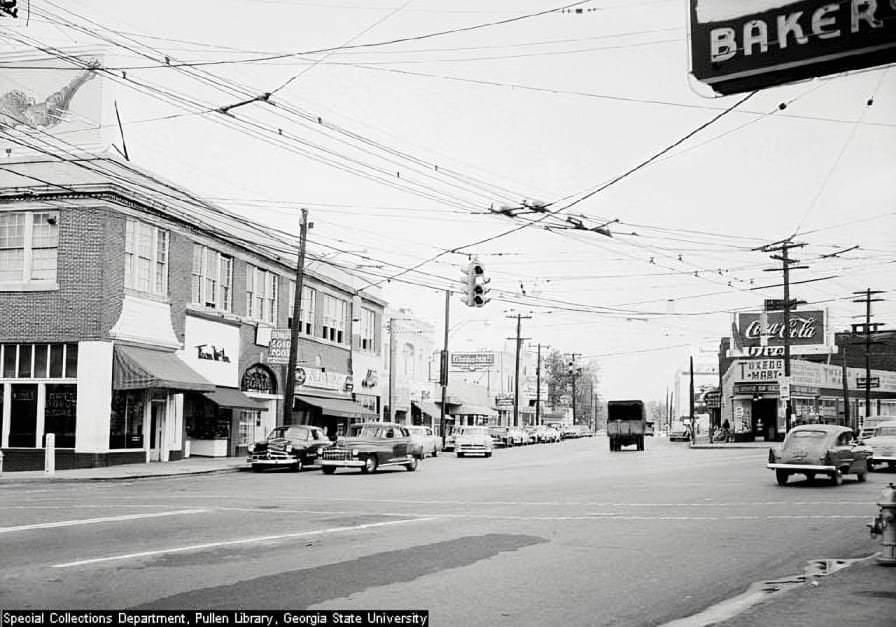
Buckhead in 1954: A glimpse into the architectural and community growth shaping the area’s character. Source: buckhead.com
The Calhoun House, also known as Trygveson, and the Canton Apartments now Crestwood Condominiums reflect the architectural innovation and luxury that came to define Buckhead in the early 1920s to the 1930s. Designed by prominent architects of the time, these buildings encapsulate the extravagance and opulence that sought to cater to Atlanta’s wealthy families looking for resplendent summer homes. As Buckhead transitioned from a rural outlier to a bustling suburban enclave, these establishments played a vital role in setting the standard for luxury living in the area.
Equally notable are the Fulton County Almshouse, now the Galloway School, and the New Hope African Methodist Episcopal Church. Each site holds a distinctive place in Buckhead’s community narrative, illustrating the intersection of social welfare, education, and spirituality in the area’s evolution. The transformation of the Almshouse into a modern educational facility and the enduring legacy of the New Hope AME Church highlight the multifaceted dimensions of Buckhead’s history, from its care for the less fortunate to the spiritual guidance provided to its African American community.
Commemorating the role of transportation and religion in Buckhead’s development, the Peachtree Southern Railway Station, now Brookwood Station, and Sardis Methodist Church stand as historical markers. The railway station, built in 1918, once facilitated the influx of visitors and residents, playing a crucial part in the area’s growth and connectivity. In contrast, Sardis Methodist Church, standing since the mid-1920s, echoes the deep-rooted spiritual life of Buckhead’s community, offering a sanctuary of peace and continuity amidst the waves of change.
Highlighting Buckhead’s antebellum and postbellum history are the Smith, Tullie, House, and Spotswood Hall. The Smith House, dating back to around 1840, is a rare survivor of the antebellum era, offering insights into the pre-Civil War lifestyle and architectural style. Spotswood Hall, on the other hand, embodies the grandeur of postbellum reconstruction and the early 20th-century refinement, representing a period of rebirth and prosperity in the South. Together, these sites narrate the tale of a region emerging from the shadows of conflict into an era of elegance and social advancement.
At the heart of Buckhead’s illustrious estates are the Swan House and the Thornton, Albert E., House. Built-in the late 1920s by renowned architect Philip T. Shutze, the Swan House captures the essence of Buckhead’s golden age of architectural grandeur and social prominence. The Thornton House, another Shutze masterpiece, further embodies the luxurious lifestyle afforded by the economic boom of the early 20th century. Visiting these iconic estates offers a glimpse into a bygone era of opulence and splendor, reflecting the aspirations and achievements of Buckhead’s most distinguished residents.
In conclusion, Buckhead’s historic sites stand as testaments to its rich legacy, each telling its own unique story of times past. From architectural marvels to cultural landmarks, these sites invite tourists and residents alike to explore and appreciate the depth of history woven into the fabric of this neighborhood. As Buckhead continues to evolve, its historical roots provide a grounding influence, reminding us of the generations that walked these streets and shaped the community’s destiny. Discovering Buckhead’s past is not just about visiting places; it’s about connecting with the stories that make this one of the most cherished neighborhoods in Atlanta.
Sources: buckheadheritage.com, buckhead.com